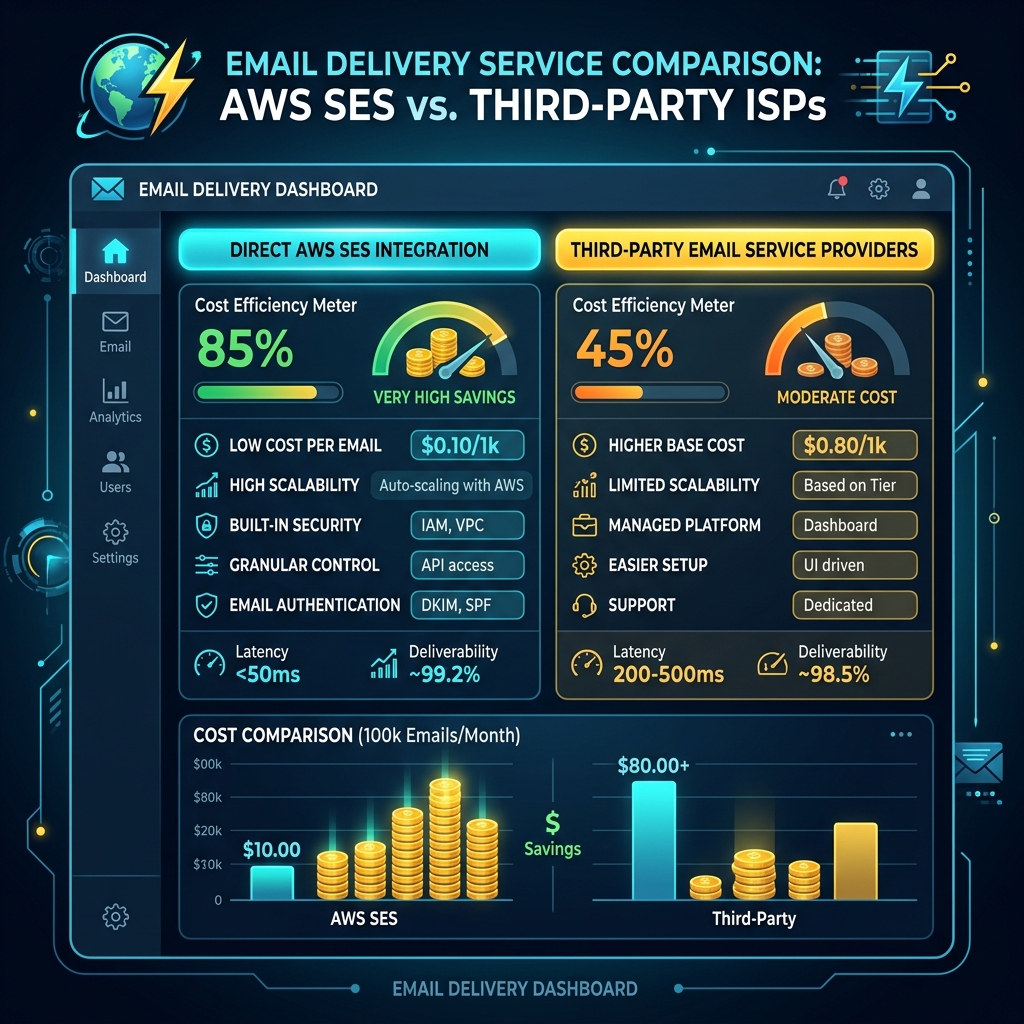
Many developers start sending emails using third-party providers like Mailgun, SendGrid, or Postmark. However, as transactional volumes scale, the raw cost of these services becomes a major operational expense.
In this guide, we analyze the pros, cons, and financial differences of integrating directly with AWS SES versus subscribing to managed third-party service providers.
---
## 1. Financial Comparison (At Scale)
Let's look at the pricing comparison tables for sending 500,000 emails per month:
| Provider | Base Tier Price | Extra Cost (Over Limit) | Total Monthly Cost |
| :--- | :--- | :--- | :--- |
| **AWS SES** | **$0.10 / 1k** | None | **$50.00** |
| **Postmark** | $385.00 (300k) | $1.00 / 1k | $585.00 |
| **Mailgun** | $75.00 (50k) | $0.80 / 1k | $435.00 |
| **SendGrid** | $379.00 (Pro) | None | $379.00 |
> [!IMPORTANT]
> At 500,000 emails/month, **AWS SES saves you over $300 to $500 monthly**. For startups, boot-strappers, and transactional platforms, this is a significant budget save that can be redirected to core product development.
---
## 2. Infrastructure Control and Setup Speed
### Third-Party Providers:
* **Pros**: Instantly setup, active dashboards, built-in analytics reports, and a simple JSON web API.
* **Cons**: Extremely expensive at scale, limited control over delivery routes, strict monthly plans.
### Direct AWS SES Integration:
* **Pros**: Direct control over sending configurations, cheap dedicated IP pricing ($24.95/month), utility-based billing.
* **Cons**: Complex domain authentication setup, manual ticket queue for sandbox removal, requires building your own bounce handler.
---
## 3. Deliverability Rates Comparison
Is the deliverability of AWS SES different from Postmark or Mailgun?
No. Email delivery depends on:
1. Domain reputation (SPF, DKIM, DMARC validation).
2. Content quality (Avoiding spam triggers).
3. IP reputation (Warming up your dedicated IP).
If both configurations are aligned, AWS SES deliverability matches or exceeds third-party providers, since AWS owns the underlying server nodes and bandwidth.